
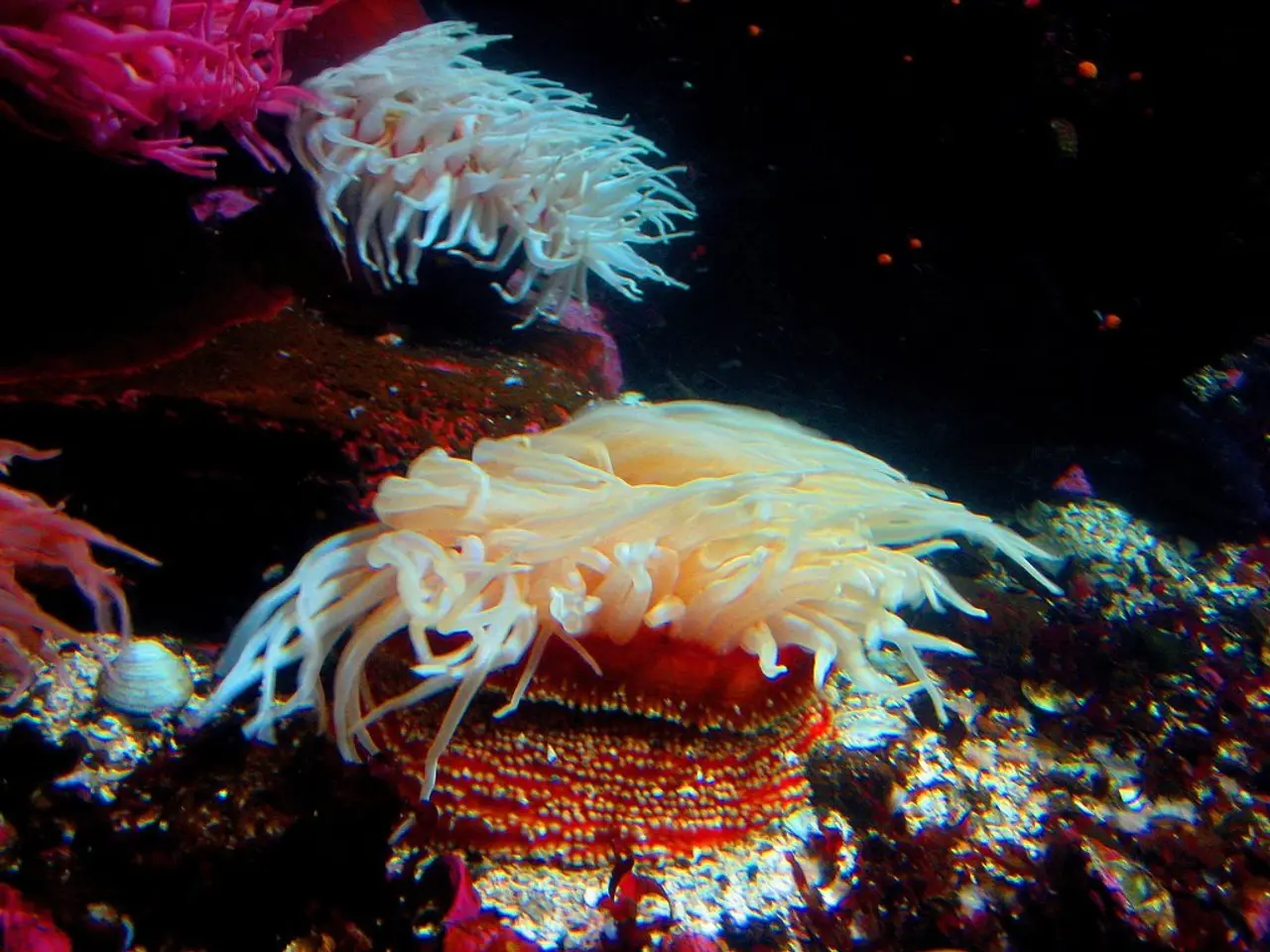
Catastrophic coral bleaching affects the Great Barrier Reef at unprecedented levels
In a series of significant developments around the globe, here's a roundup of the latest news:
US-Brazil Trade Tensions Escalate
US President Donald Trump has threatened to impose 50% tariffs on Brazilian imports, starting tomorrow, over what he perceives as a "witch hunt" against the rightist leader. This move comes amidst a resilient world economy, but with cracks beginning to emerge and the US' recession risk elevated, as warned by Goldman Sachs economists.
Defense Tech Firm Palantir Thrives Under Trump
Defense technology firm Palantir topped $1 billion in quarterly revenue for the first time, following millions in US government contracts under President Trump's second term.
Oil Market Shifts
Some Indian refiners have stopped buying Russian oil, turning to Middle East and West African suppliers instead. This move comes after US President Donald Trump threatened tariffs on Russian oil buyers, aiming to drive up crude prices and impact India and China, Moscow's biggest customers.
Great Barrier Reef Suffers Worst Bleaching
Heat stress driven by warming oceans has severely affected the Great Barrier Reef, causing unprecedented and widespread coral bleaching and sharp declines in coral cover. The reef suffered its worst bleaching on record during 2024 and early 2025, with heat stress from soaring ocean temperatures triggering the most spatially extensive and severe coral bleaching documented in almost 40 years of monitoring.
Political and Economic Developments
- Diplomats are in Geneva for what was meant to be the final round of negotiations over a global treaty to curb plastic pollution. However, opposition from the US and other oil-producing states has dimmed hopes for success.
- US President Donald Trump's latest tariff hikes have injected fresh uncertainty into international markets, underscoring Trump's remaking of the global economic order.
- The kingdom's non-oil economy has overtaken the fossil-fuel one, but it faces huge challenges, including a widening government deficit and persistent vulnerability to crude prices.
- In just months, Washington's effective tariff rate has risen by more than 15 percentage points, as Trump wielded economic and geopolitical power to exert his protectionist will on other nations.
- Apple will invest an additional $100 billion in US manufacturing, following its $500 billion pledge earlier this year, after pressure from US President Donald Trump to reduce reliance on Asian supply chains.
- Brazil's Supreme Court put former President Jair Bolsonaro under house arrest ahead of his trial over an alleged coup plot.
Conflicts and Diplomacy
- US and Israeli officials backed a new plan to end the war in Gaza through one agreement rather than piecemeal truces, as talks with Hamas stall.
- Israeli Prime Minister Benjamin Netanyahu is reportedly pushing for a full occupation of the Gaza Strip in a massive expansion of the country's military operations in the enclave.
- China and Russia opened joint naval drills in the Sea of Japan, the latest sign of their strengthening alliance on both tactical and strategic levels.
- US special envoy Steve Witkoff held talks with Russian President Vladimir Putin in Moscow with dim hopes for any major breakthrough in ending the war in Ukraine.
Technology and Health
- Governments' embrace of artificial intelligence is boosting the fortunes of certain Silicon Valley companies.
- Measles, once on the verge of being defeated globally, is surging again due to vaccine skepticism.
- US Health Secretary Robert F. Kennedy Jr cancelled $500 million in funding for mRNA vaccine research.
- The number of people going hungry worldwide fell by 15 million between 2023 and 2024, a new report said. However, child stunting and food insecurity levels fell, while adult obesity went up: Since 2016, there have been more obese people worldwide than underweight ones.
- In just months, Washington's effective tariff rate has risen by more than 15 percentage points, as Trump wielded economic and geopolitical power to exert his protectionist will on other nations.
Energy
- The group has been hiking production since April in a bid to cushion the market against geopolitical tensions, and the decision to increase oil output by 547,000 barrels per day would fully reverse a 2023 2.2 million-barrel cutback aimed at shoring up prices.
- BP said it made its largest global oil and gas discovery in 25 years off the coast of Brazil, boosting the British major's efforts to refocus on fossil fuels and shift away from renewables.
- Aramco's dividends power Riyadh's $1.15 trillion sovereign wealth fund, but the company's shares are underperforming those of other major oil and gas firms.
- Tesla is giving Elon Musk $29 billion in stock to keep his "energies focused" on the carmaker rather than his sprawling space, AI, and brain-science empire.
Controversies
- Bolsonaro is accused of breaching pre-trial restrictions despite wearing an ankle monitor. His conviction is seen as necessary to defend democracy in Brazil.
- A hard-right Israeli minister sparked fury by praying at a disputed holy site in Jerusalem, defying decades-old agreement that Jews can visit but not pray there.
- Negotiations over a global treaty to curb plastic pollution resume today, but opposition from the US and other oil-producing states has dimmed hopes for success.
- The change is driven by falling vaccination rates, with the lowest rates among ethnic minorities. In London, just 73% of five-year-olds are vaccinated.
- Southern Asia and Latin America saw particular gains as the percentage of the world's population experiencing food shortages fell from 8.7% in 2022 to 8.5% in 2023 and 8.2% last year, the World Health Organization said.
- Pakistan hails closer ties with Washington, while India faces escalating economic pressure from the US.
- Russia reportedly doubts Donald Trump will follow through on a ceasefire ultimatum, believes that compromise is pointless, and thinks a limited aerial truce may be enough to satisfy Trump.
- The strategy contrasts with that of Pakistan, which landed a more favorable US tariff rate of 19%, in part because of Trump's interest in the country's oil reserves, but also because Islamabad "didn't ruffle feathers on the geopolitical front," an expert told Nikkei.
- Members of the oil producers' group OPEC+ agreed to raise production as concerns grow over possible disruptions to Russian supply.
- Record number of Chinese companies are publicly listing in the US, despite poor ties between the two superpowers.
- Canada has had more cases than the entire US this year, and the European Union saw an almost tenfold annual increase in reported cases to more than 35,000 in 2024.
- The number is projected to fall further, from last year's estimate of 673 million to a predicted 512 million by 2030, but progress is not even: Sub-Saharan Africa and Western Asia worsened.
- Bleached coral can recover, but if temperatures remain high for long periods or if it faces too many bleaching events in quick succession, it will die.
- Saudi Arabia's state oil giant Aramco reported a 10th consecutive quarterly profit decline, threatening the kingdom's economic transformation.
This roundup offers a snapshot of the diverse and dynamic events shaping our world today. Stay tuned for more updates as these stories continue to unfold.
Science advancements in the realm of health-and-wellness are being bolstered by government's increasing investment in artificial intelligence, potentially leading to breakthroughs in disease prevention and treatment.
The escalating climate crisis, evident in the Great Barrier Reef's worst bleaching on record, underscores the need for urgent scientific research and policy changes in order to combat the ongoing health impacts on marine ecosystems and human populations.




