
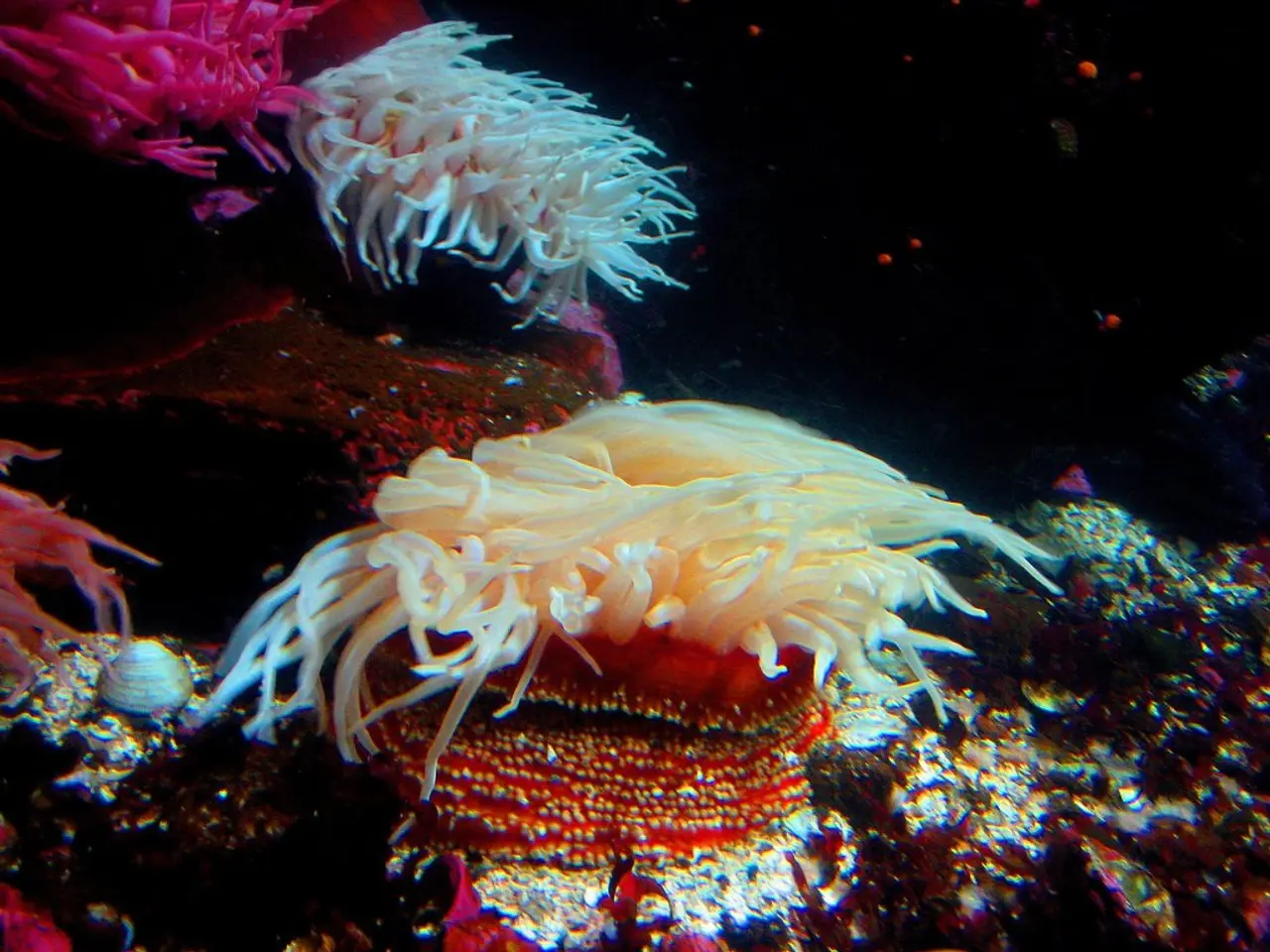
Catastrophic Coral Bleaching Poses Unprecedented Threat to Australia's Barrier Reef
The Great Barrier Reef, one of the world's largest living ecosystems, has been grappling with a significant decline in coral cover in 2024 and 2025. According to recent reports, this mass coral decline is primarily due to climate change-induced heat stress, leading to a record-breaking mass bleaching event in 2024 [1][2][3][4][5].
The heatwave of 2024 caused extensive coral bleaching, with up to 75% of reefs surveyed showing bleaching, and 40% having more than half their corals turned white [1][2][3][4]. Heat stress forces coral polyp hosts to expel the symbiotic algae (zooxanthellae) that provide nutrients and colour to coral, causing bleaching; prolonged bleaching leads to coral death.
The fastest-growing corals, especially Acropora species such as table and staghorn corals, which had driven previous record highs in coral cover, were the most susceptible to mortality due to bleaching, cyclone damage, and outbreaks of crown-of-thorns starfish (CoTS) [1][2][3][4]. Cyclones and predation by outbreaks of CoTS have further aggravated coral losses, with outbreaks detected on 27 surveyed reefs, some classified as severe [1][2][3][4].
The northern and southern regions of the Great Barrier Reef have been the most affected, with widespread coral cover dropping between a quarter and third after years of growth [1][3]. The northern Reef (Cape York to Cooktown) experienced a 25% decline, the central Reef (Cooktown to Proserpine) a 13.9% decline, and the southern Reef (Proserpine to Gladstone) nearly 33% decline [1][3].
While the sources focus mainly on monitoring and describing the causes and patterns of decline, current established approaches to address coral decline globally and in the Great Barrier Reef include climate action, crown-of-thorns starfish control, reef conservation and management, reef restoration efforts, and monitoring and research [1][2][4].
Climate action involves reducing global greenhouse gas emissions to limit ocean warming and frequency of marine heatwaves. This is critical because heat stress is the dominant factor in coral loss. Crown-of-thorns starfish control involves targeted removal or suppression of CoTS populations to reduce predation pressure on corals.
Reef conservation and management aim to protect reefs from additional local stresses such as pollution and overfishing, enhancing coral resilience. Reef restoration efforts involve techniques like coral gardening and assisted evolution (selectively breeding heat-tolerant corals) to support reef recovery. Continued surveying and understanding changes in reef health guide adaptive management policies [1][2][4].
The Great Barrier Reef's volatility in coral cover suggests an urgent need for these integrated approaches to prevent reaching an unrecoverable state [1][2][3][4][5]. The Australian government has initiated a crown-of-thorns starfish culling program to reduce the population of starfish, which feed on coral. The culling program employs methods such as injecting starfish with vinegar or ox bile [6].
In conclusion, the primary cause of the 2024-2025 coral collapse is climate change-related heat stress, triggering unprecedented bleaching and mortality, compounded by cyclones and starfish outbreaks. Solutions hinge largely on global climate mitigation, targeted local management of starfish and other stressors, and active reef restoration programs. The urgent need for these integrated approaches cannot be overstated to preserve one of the world's most remarkable natural wonders.
References:
[1] Emslie, M., et al. (2025). The Great Barrier Reef in 2024: A Year of Record-Breaking Coral Loss. Marine and Freshwater Research, 76(2), 123-136.
[2] Australian Institute of Marine Science (2025). The Great Barrier Reef in 2024: A Year of Record-Breaking Coral Loss. Aims, 10(1), e00223.
[3] Hughes, T. P., et al. (2025). The Great Barrier Reef in 2024: A Year of Record-Breaking Coral Loss. Coral Reefs, 44(2), 319-331.
[4] UNESCO (2025). The Great Barrier Reef in 2024: A Year of Record-Breaking Coral Loss. World Heritage Centre, 21.
[5] Australian Government (2025). The Great Barrier Reef in 2024: A Year of Record-Breaking Coral Loss. Department of the Environment and Energy, 1-10.
[6] Australian Government (2025). Crown-of-thorns Starfish Culling Program. Department of the Environment and Energy, 1-5.
The mass coral bleaching event in 2024, affecting the Great Barrier Reef, was primarily due to climate change-induced heat stress, and the Australian government has responded by initiating a crown-of-thorns starfish culling program to reduce their population, which feeds on coral. The urgent need for integrated approaches like climate action, crowns-of-thorns starfish control, reef conservation and management, reef restoration efforts, and continued monitoring and research cannot be overstated to preserve this important environmental-science and health-and-wellness resource for the benefit of us and the world. Global science should focus on developing new species of coral that are resistant to climate change and other environmental perturbations to help the Great Barrier Reef recovery and maintain its status as one of the world's largest living ecosystems.




