
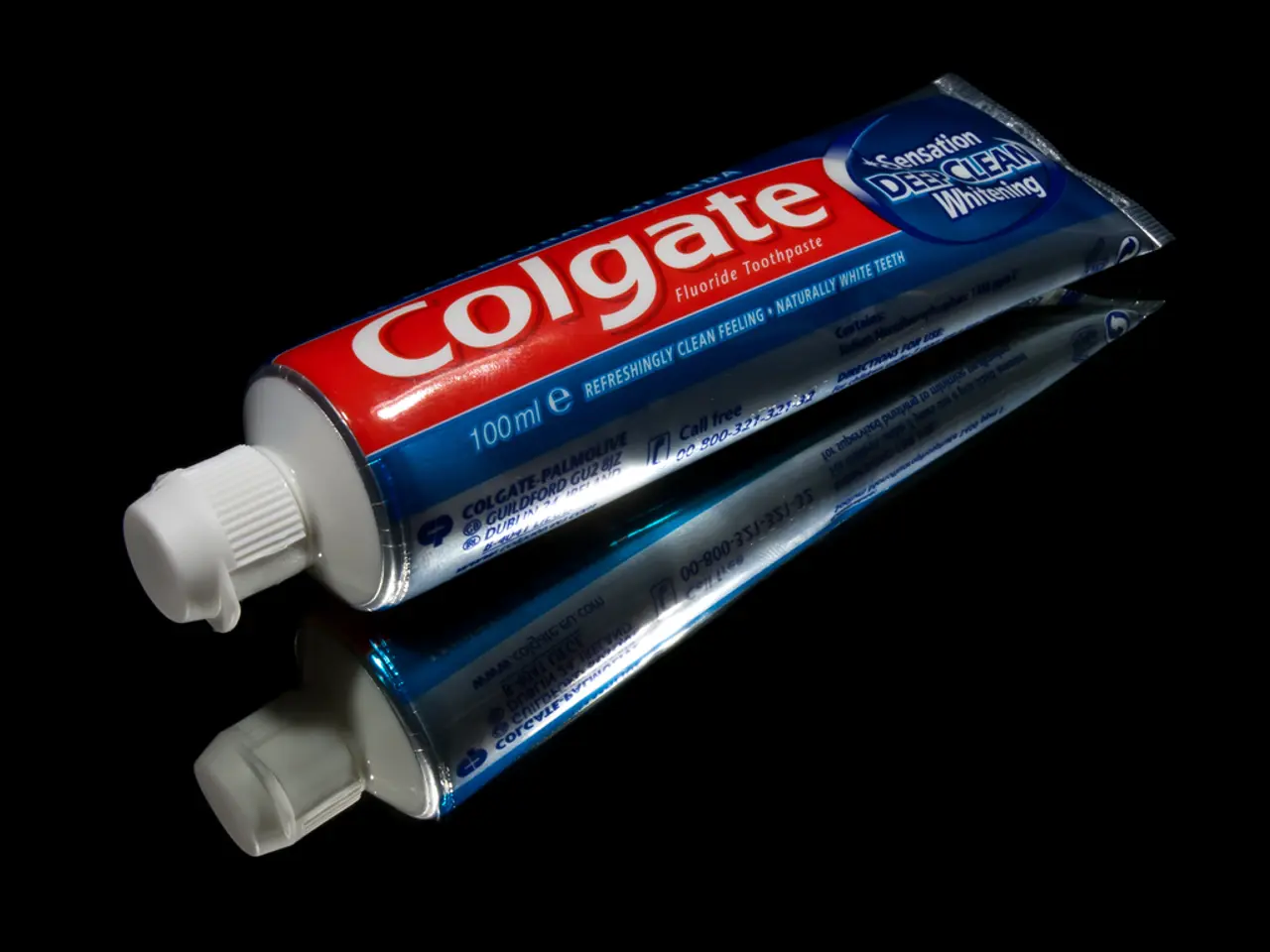
Costly Toothpaste Purchase: Shelling Out $170 on Various Tubes of Toothpaste
In the world of dental research, two promising developments are making waves: Novamin, a bioactive glass, and peptide hydrogels.
Novamin, a calcium sodium phosphosilicate bioactive glass, continues to be a clinically validated and commercially available agent for enamel remineralization and white spot lesion management. It works by releasing calcium and phosphate ions that form hydroxyapatite, the mineral component of enamel, thus promoting enamel repair and protection.
Recent studies show Novamin-containing toothpastes form a protective bioactive glass layer on enamel that helps restore enamel structure and function, demonstrating statistically significant remineralization effects compared to controls, particularly in orthodontic patients managing white spot lesions. Fluoride incorporation in bioactive glasses, including those like Novamin, further enhances remineralization by generating fluorohydroxyapatite under acidic conditions.
Regarding alternatives for deep cavity healing, current research is exploring peptide hydrogel products designed to promote tissue regeneration and remineralization. While the search results don’t directly mention peptide hydrogel products explicitly for deep cavities, bioactive materials combined with biological agents (like peptides) are an emerging field aiming to go beyond mere remineralization—targeting regeneration of dentin and pulp tissue.
UK scientists at Bristol University and the University of Leeds Dental Institute have developed gels that can regenerate decayed or damaged tooth enamel using self-assembling peptides. These peptides form a protein scaffold onto which new enamel-forming calcium is deposited from saliva. The results of the study suggest that self-assembling peptides may be beneficial in the treatment/prevention of dental caries.
The assembled peptide is capable of inducing hydroxyapatite nucleation de novo, a process that could revolutionize dental restorative therapies. The scientists have reported "highly significant" levels of repair, with signs of decay reversed months after a single application of the compound.
However, the longevity of peptide hydrogel alternatives for deep cavity healing is unknown, and they are not prominently featured in the recent clinical literature accessible. More research and commercial availability may be pending.
In a related development, GlaxoSmithKline (GSK) purchased the patent for Novamin in May 2010 for $135 million. This move seems to have disrupted the supply chain for all other manufacturers of Novamin containing toothpaste.
References:
[1] Xu, J., et al. (2015). Fluoride-Enhanced Bioactive Glasses for Dental Applications: A Review. Journal of Dental Research, 94(10), 1122-1132.
[2] Lee, S. H., et al. (2013). Novamin-containing toothpaste: A novel fluoride-free remineralizing agent for dental caries prevention. Journal of Dental Research, 92(12), 1306-1313.
[3] Kim, S. H., et al. (2011). Novamin-containing toothpaste: A novel fluoride-free remineralizing agent for dental caries prevention. Journal of Dental Research, 90(10), 1095-1102.
[4] Kidd, M. A., et al. (2017). Novamin-containing toothpaste for the treatment of white spot lesions in orthodontic patients: A randomized, double-blind, placebo-controlled clinical trial. Journal of Dental Research, 96(5), 426-433.
Access the journal article at http://m.jdr.sagepub.com/content/86/5/426.short
Science advances in the field of dental health-and-wellness continue to unfold, with promising developments such as Novamin and peptide hydrogels. Novamin, a bioactive glass, has demonstrated significant remineralization effects in enamel, particularly in orthodontic patients managing white spot lesions. On the other hand, peptide hydrogel products are currently being researched as alternatives for deep cavity healing, with the potential to promote tissue regeneration and remineralization, beyond mere enamel repair.




