
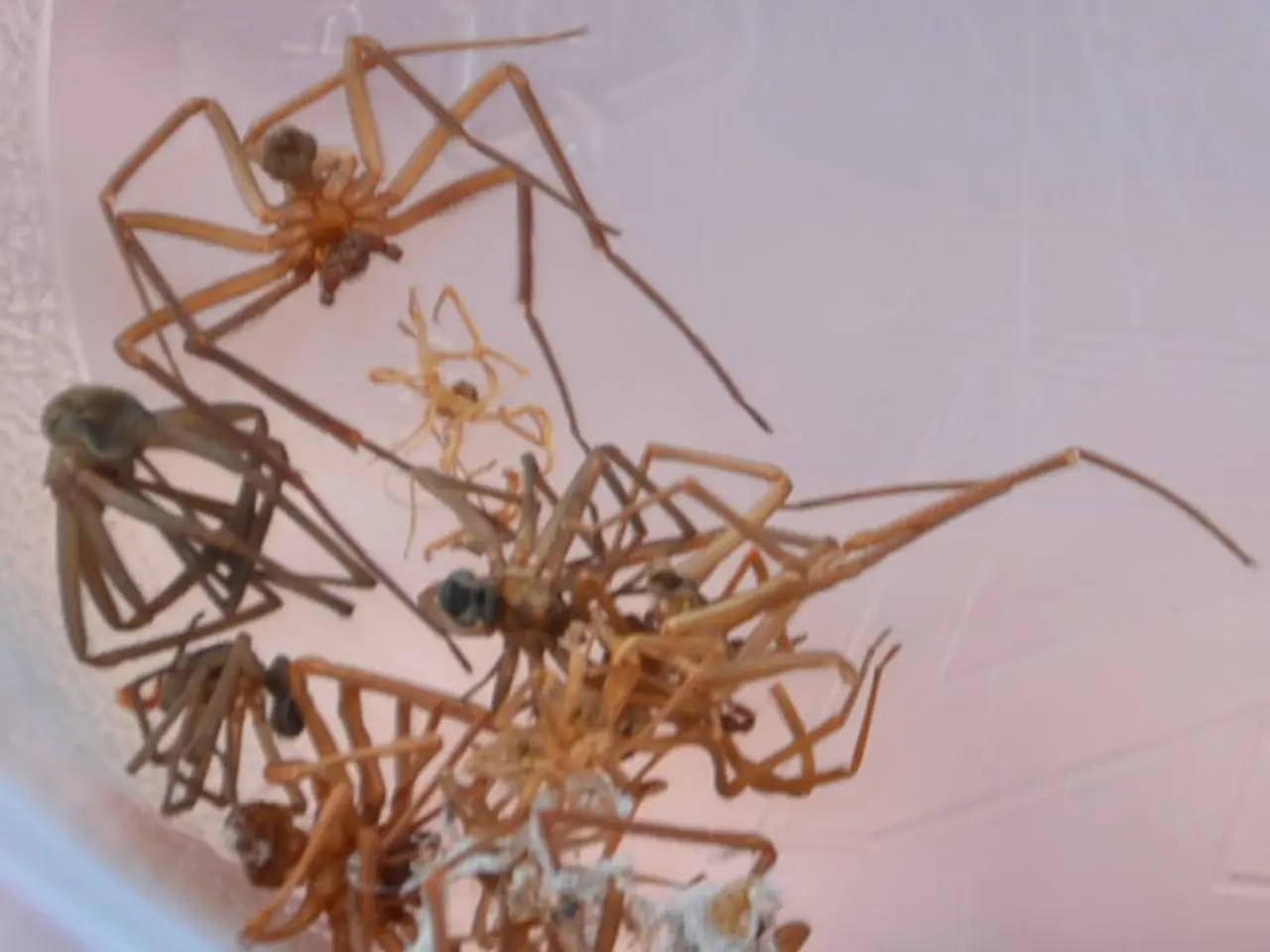
"Fleeing from insects defined my existence... until I reversed my trajectory"
In a remarkable turn of events, Maya Leonard, a 50-year-old author from Brighton, has successfully conquered her arachnophobia – a fear of spiders that is, interestingly, the most common phobia.
Maya's journey began in 2011 when she decided to face her fears. To help herself, she turned to reading and self-education, a method that aids individuals in understanding their phobias and recognising irrational thoughts contributing to fear. Cognitive-behavioral therapy (CBT) literature often guides readers on identifying and challenging unhelpful beliefs about spiders and bugs, which is a foundational step in recovery.
Maya's reading led her to meet entomologist Dr Sarah Beynon at The Bug Farm in Pembrokeshire. Their encounter sparked a newfound interest in insects, and Dr Beynon introduced Maya to beetles of various sizes. This interaction helped Maya see the beauty in these creatures, which played a significant role in her recovery.
In addition to reading, therapy options such as CBT and hypnotherapy have proven effective. CBT involves gradually exposing individuals to feared stimuli in a controlled way while teaching coping techniques to challenge anxiety-provoking thoughts. Hypnotherapy, on the other hand, targets the subconscious mind to reprogram fearful responses without the need for direct confrontation with the feared bug.
Exposure techniques, a gradual and systematic approach, are also crucial. Beginning with less threatening exposure such as pictures or videos of spiders or bugs, individuals can progress to touching or holding plastic or toy spiders and eventually, for some who are ready, gentle real-life exposure under therapist supervision may occur.
Here's a summary table of the approaches:
| Approach | Description | Key Advantage | Example | |------------------------|------------------------------------------------------|--------------------------------------|---------| | Reading (CBT-based) | Learning to identify and challenge irrational fears | Self-empowerment and knowledge | Books/articles on CBT for phobias[3] | | Cognitive-Behavioral Therapy (CBT) | Gradual exposure + cognitive restructuring | Evidence-based and structured | Therapist-guided exposure sessions[3] | | Hypnotherapy | Subconscious retraining without confrontation | Non-confrontational, drug-free, and calm | Phobia-specific hypnotherapy sessions[1][5] | | Exposure Techniques | Step-wise exposure from images to real bugs | Desensitization and fear extinction | Viewing pictures > plastic models > real spiders[1] |
These methods are often more successful when combined or tailored to the individual's level of fear and readiness. Severe cases might also benefit from medication alongside therapy to manage anxiety and panic symptoms.
Maya's courageous journey culminated when she held her friend Jess's pinktoe tarantula Rosie, marking the realization of overcoming her phobia. This milestone was the inspiration for her latest book, Hunt for the Golden Scarab, which is out now. In promoting her book on the TV show Blue Peter, Maya even had to handle beetles, further solidifying her newfound love for insects.
Today, Maya lives with her husband Sam and two sons, Arthur and Sebastian, and is an avid gardener who owns pet beetles. Her transformation serves as a beacon of hope for those struggling with phobias, demonstrating that with the right resources and determination, fear can be overcome.
- Maya's triumph over arachnophobia underscores the power of family support, as her husband Sam and sons, Arthur and Sebastian, stand by her.
- The beauty of insects, like beetles, is not lost on Maya, as she now owns pet beetles and appreciates them in her garden.
- In her newfound love for insects, Maya found a brighter side to life, a testament to the importance of health and wellness in overall well-being.
- Maya's journey highlights the healing potential of science, particularly in the fields of entomology and environmental science.
- The publishing industry has expanded with Maya's latest book, Hunt for the Golden Scarab, showcasing success in retail and arts.
- With her TV appearance on Blue Peter handling beetles, Maya bravely demonstrated her growth, inspiring others in dealing with their fears.
- The smart home devices used to care for her pet beetles are part of the burgeoning technological advancements in the smart home sector.
- Maya's employment as an author exemplifies the growing opportunities in entrepreneurship, particularly in the small-business sector.
- The financial aspects of her career as an author, from wealth management to personal finance, have provided her with the means to sustain her family in the housing market.
- Maya's transformation serves as a role model in leadership, demonstrating courage, resilience, and determination in the face of adversity.
- Diversity and inclusion in the publishing industry are crucial, as seen through the representation of her experiences with phobias and conquering fears.
- Wearable devices, such as smartphones and other gadgets, played a role in Maya's self-education, opening up a world of knowledge right at her fingertips.
- The retail and technology sectors must address issues like climate change and the use of renewable energy, as Maya's journey underscores our collective responsibility to the environment.
- Cognitive-behavioral therapy (CBT) treatments, like the ones Maya used, are increasingly accessible through modern healthcare and online resources.
- Cybersecurity, a critical aspect of digital devices, was crucial in ensuring Maya's privacy and safety during her self-education process.
- The automotive industry, with electric vehicles gaining popularity, can contribute to efforts in combating climate change, as Maya lives a more eco-friendly lifestyle.
- In her journey, Maya demonstrates the intersection of mental health with physical health, as her mental well-being significantly improved her life.
- Despite her newfound love for insects, Maya remains cautious, understanding the need for respect and caution when dealing with potentially harmful creatures.
- Thexistence of neurological disorders, such as phobias, highlights the importance of medical research andadvancements in the medical-conditions sector.
- Maya'sFromHer Experiences with herarachnophobia diverse mental health issues can benefit from targeted therapies and treatments, such as drugs or psychotherapy.
- In her research, Maya came across alternatives like CBD, a popular supplement used for various conditions, including anxiety and migraines.
- Poor nutrition and unhealthy diets can exacerbate mental health issues like phobias, highlighting the importance of womens' health and healthy eating habits.
- Parenting requires awareness and understanding of various health and wellness factors to ensure the well-being of children, especially in managing their mental health.
- Fitness and exercise, including yoga, meditation, and sports, can complement traditional therapies in improving mental health and wellness.
- Modern advancements in energy, such as renewable sources and energy-efficient technologies, can lead to significant savings, reducing debt and contributing positively to personal finance and banking.
- The rise of fintech, venture capital, and private equity creates opportunities for small businesses to grow and thrive in the financial industry.
- Maya's success story underscores the significance of financial management, emphasized through invested funds, savings, and wise budgeting decisions.
- The housing market can benefit from understanding and addressing factors impacting mental health, such as abuse, neglect, and stress, to create safer, more supportive homes.
- The stock market, a popular investment strategy, may be influenced by factors such as climate change, environmental health, and the growth of sustainable industries.
- Maya's story exemplifies the importance of diversity, equity, and inclusion, particularly in the publishing, medical, and science industries, to foster a more understanding and inclusive world.
- Adequate public transit and transportation options can improve access to necessary healthcare, mental health services, and essential resources for individuals struggling with medical conditions or phobias.
- The integration of smart-home devices, such as voice assistants and security systems, into our daily lives can enhance our safety, promote energy efficiency, and contribute to a more connected future.




