
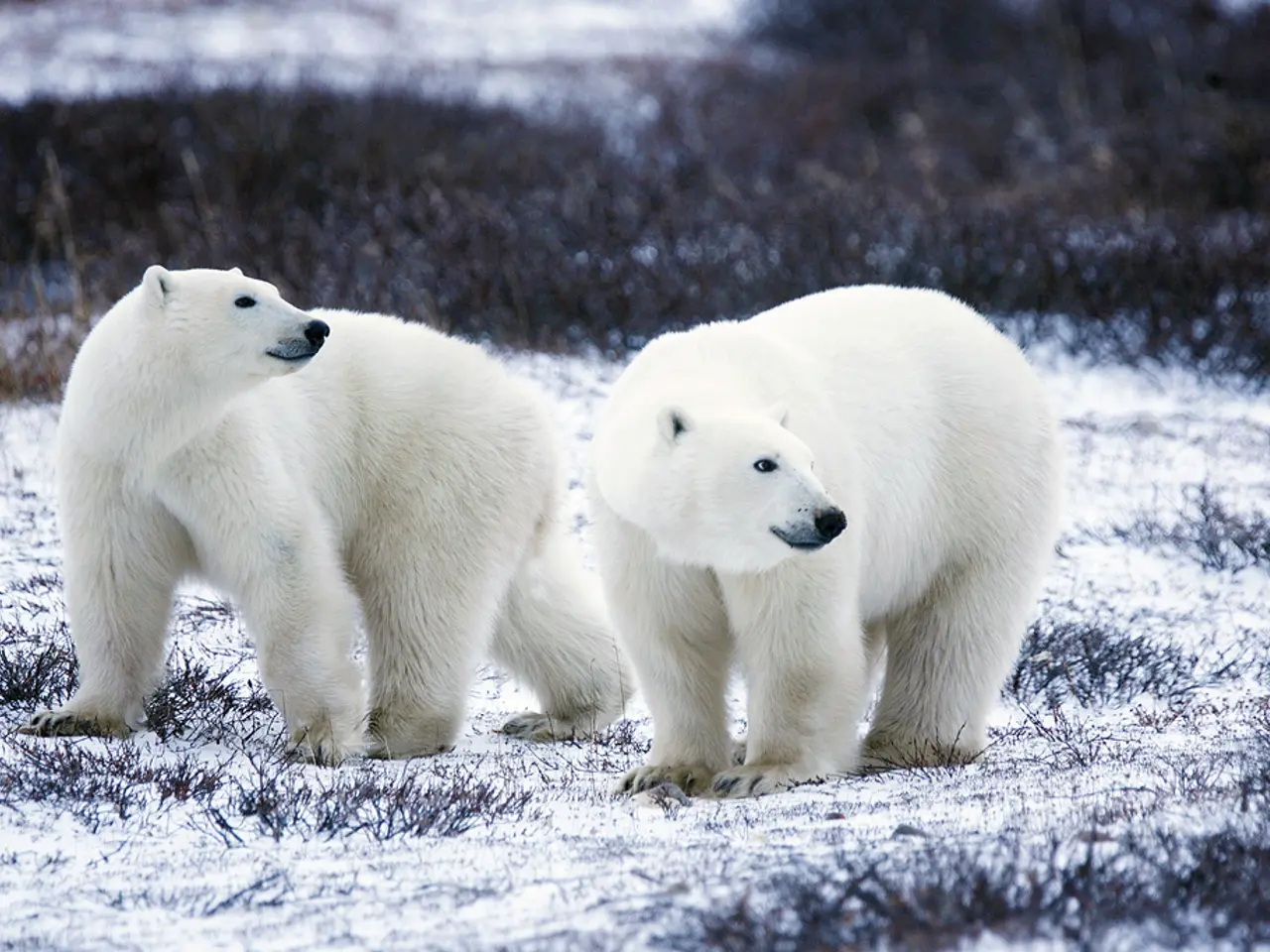
Polar bear survival tactics in cold winter climates
The "Around the World in 50 Experiments" series continues with a fascinating exploration of the insulating properties of blubber, as demonstrated in a simple experiment. This post was last updated on July 11, 2025, by Emma Vanstone.
Polar bears, native to the Arctic, are remarkable creatures that have adapted to survive in one of the coldest environments on Earth. Their amazing sense of smell can detect seals, their primary food source, from a distance of 1km [1].
One of the key adaptations that help polar bears thrive in the Arctic is their thick layer of blubber. This layer of fat, located beneath the skin, acts as an insulator, preventing heat from easily escaping [2]. In the blubber experiment, materials such as lard or shortening, latex gloves, ice or snow, water, a washing up bowl, a stopwatch, and (optionally) a thermometer, are used to demonstrate this insulation [3].
The insulating properties of blubber are evident when comparing the sensation of cold in the blubber experiment. Participants place their hands in ice water without gloves, and then with gloves covered in lard. The lard acts as an insulator, protecting the hand from the cold of the icy water [4].
This thick layer of blubber also serves as a food store when food is scarce. Polar bears can live to around 30 years old, and during the winter months when seals are less abundant, their blubber provides a vital energy reserve [5].
While polar bears live only at the North Pole, they have adapted to the cold in unique ways. Their hollow, colorless fur traps the sun's heat, and the black skin under the fur helps to further trap heat [6]. Interestingly, some animals, such as polar bears, do not hibernate or migrate for winter but instead adapt to the cold by growing warmer fur or a layer of insulating fat [7].
However, polar bears are not immune to the effects of summer heat. They can overheat when temperatures are at their highest and often roll in the snow to cool down [8].
This post provides a captivating glimpse into the world of polar bears and the remarkable adaptations that allow them to survive in the Arctic. The blubber experiment is a simple and engaging way to understand these adaptations and appreciate the incredible resilience of these magnificent creatures.
[1] Polar Bears International. (n.d.). Polar Bear Facts. Retrieved July 11, 2025, from https://www.polarbearsinternational.org/polar-bears/polar-bear-facts/ [2] National Geographic Society. (2021). Blubber. Retrieved July 11, 2025, from https://www.nationalgeographic.org/encyclopedia/blubber/ [3] Science Buddies. (n.d.). Blubber Insulation Experiment. Retrieved July 11, 2025, from https://www.sciencebuddies.org/science-fair-projects/project_ideas/Animal_p042/mammals_vertebrates/blubber_insulation [4] University of California Museum of Paleontology. (n.d.). Blubber. Retrieved July 11, 2025, from https://www.ucmp.berkeley.edu/mammal/cetacea/whale/blubber.html [5] Polar Bears International. (2021). Polar Bear Lifespan. Retrieved July 11, 2025, from https://www.polarbearsinternational.org/polar-bears/polar-bear-facts/polar-bear-lifespan/ [6] National Geographic Society. (2021). Polar Bear Fur. Retrieved July 11, 2025, from https://www.nationalgeographic.org/encyclopedia/polar-bear-fur/ [7] National Geographic Society. (2021). Adaptations of Polar Bears. Retrieved July 11, 2025, from https://www.nationalgeographic.org/encyclopedia/adaptations-polar-bears/ [8] Polar Bears International. (2021). Polar Bear Behavior. Retrieved July 11, 2025, from https://www.polarbearsinternational.org/polar-bears/polar-bear-facts/polar-bear-behavior/
- Children can learn about the insulating properties of blubber, a key adaptation in polar bears, through a simple activity like the blubber experiment, which involves materials such as lard, ice, and water, often used in the "Around the World in 50 Experiments" series.
- Understanding the importance of insulation in polar bears' survival isn't just confined to science class; it extends to health-and-wellness and fitness-and-exercise, as maintaining an adequate insulating layer is crucial for cold-weather survival.
- The around-the-world exploration of scientific phenomena has led to the investigation of various adaptations, like blubber, which are vital for animals to thrive in their specific environments, like the Arctic.
- Environmental-science education often delves into the unique characteristics that allow animals to survive in extreme environments, such as the thick layer of blubber found in polar bears.
- As we engage in activities like the blubber experiment, we're not only experiencing science at work but also gaining a deeper appreciation for the incredible resilience and adaptations exhibited by these magnificent creatures that inhabit our diverse planet.




