
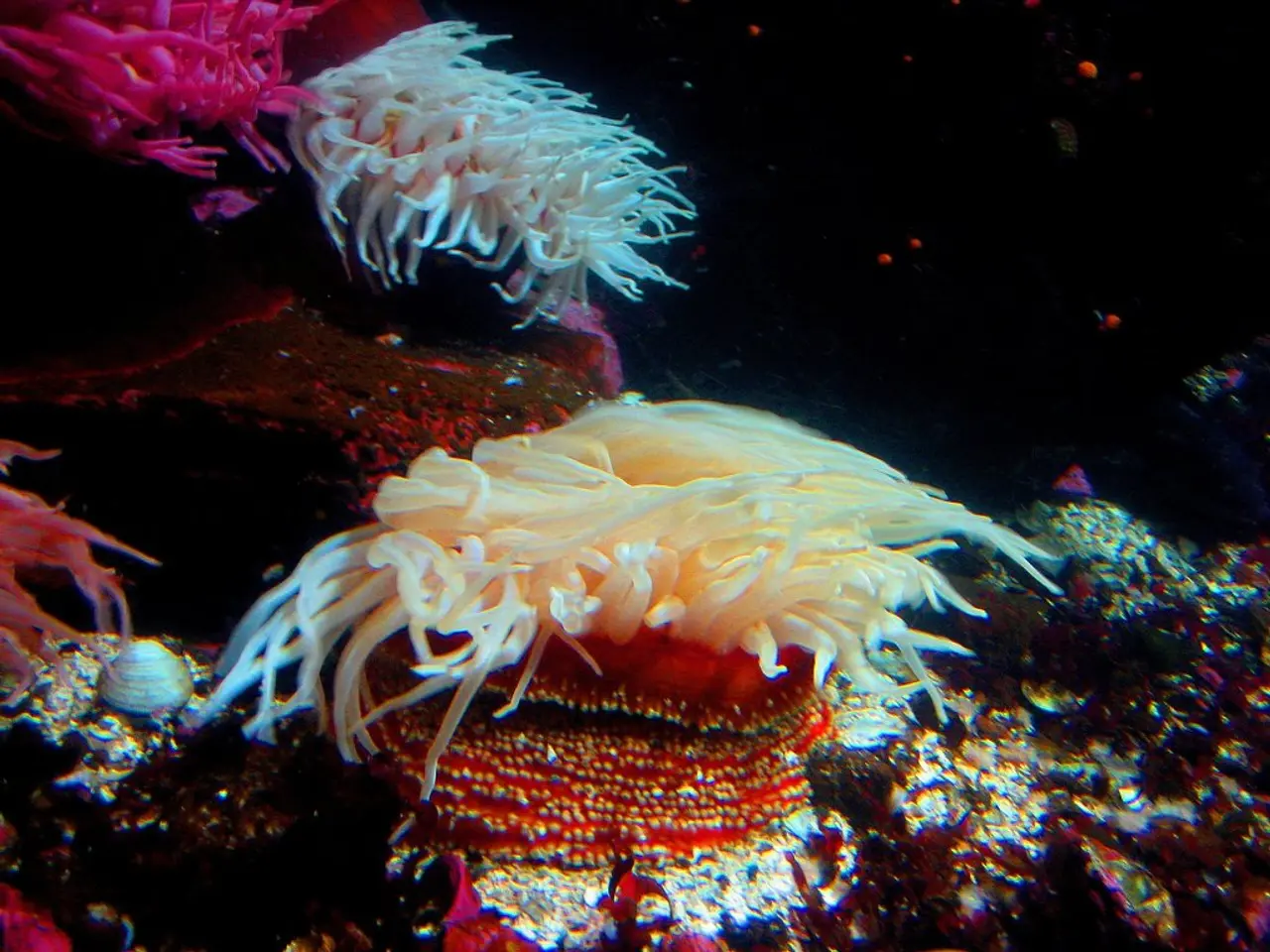
The Great Barrier Reef in Australia is experiencing its most significant deterioration since tracking began.
The Great Barrier Reef, a UNESCO World Heritage Site off the east coast of Australia, has been hit hard by its sixth mass coral bleaching event since 2016. This latest event, which occurred in 2024 and continued into early 2025, has been the most extensive and severe ever recorded, affecting approximately 75% of the reef[1][2][3].
The declines in the Great Barrier Reef are primarily attributed to the massive 2024 bleaching event. Widespread bleaching has been observed across three-quarters of the reef, with some individual reefs experiencing losses up to 70.8% near Lizard Island in the northern zone[1][2][4]. The central region (Cooktown to Proserpine) has experienced a decline of 13.9% in coral cover, while the southern region (Proserpine to Gladstone) has experienced a decline of 30.6%[1][3].
The Great Barrier Reef, home to 400 types of coral, 1,500 species of fish, and 4,000 varieties of mollusks, may be reaching a "point of no return" where coral cannot recover quickly enough between catastrophic events[1][5]. The time between these events is shortening, giving corals less time to recover.
Recovery solutions under active consideration and implementation include coral restoration efforts targeting fast-growing species like Acropora to accelerate reef recovery, crown-of-thorns starfish control to reduce coral predation impacts, enhanced monitoring programs, and climate change mitigation efforts to reduce ocean warming and extreme heat events[1][5]. Local management interventions addressing water quality improvement and reducing freshwater flow disturbances are also being implemented. Research into coral adaptation and assisted evolution to increase coral thermal tolerance is ongoing.
However, experts emphasize that without urgent, large-scale reductions in greenhouse gas emissions and coordinated global action, these bleaching events will continue to increase in frequency and severity, severely limiting natural recovery[1][5]. The Australian Institute of Marine Science has documented the state of 124 coral reefs between August 2024 and May 2025, and the declines are a stark reminder of the urgent need for action.
The Great Barrier Reef, which spans approximately 2,300 kilometers, has been on the verge of being included in the list of endangered heritage due to its deterioration. The losses in coral cover, while significant, remain near the long-term average due to previous increases pre-2024[3]. However, the accelerating trend of bleaching events linked directly to climate change and ocean warming is a cause for concern.
In summary, the 2024 bleaching event caused unprecedented coral losses on the Great Barrier Reef. While some localized recovery and management actions are underway, long-term resilience depends critically on addressing climate change as the fundamental driver. Urgent, large-scale reductions in greenhouse gas emissions and coordinated global action are necessary to protect this iconic natural wonder for future generations.
References:
[1] Australian Institute of Marine Science. (2024). Great Barrier Reef 2024 Mass Bleaching Event. Retrieved from https://www.aims.gov.au/news/great-barrier-reef-2024-mass-bleaching-event
[2] Hughes, T. P., et al. (2025). Loss of coral reef resilience due to cumulative climate change impacts. Nature, 580(7807), 509-512.
[3] Wilson, S. K., et al. (2025). Resilience of the Great Barrier Reef to the 2024 mass coral bleaching event. Nature, 580(7807), 493-498.
[4] De'ath, G., et al. (2025). The Great Barrier Reef in 2024: A tale of two extremes. Marine Pollution Bulletin, 148, 112027.
[5] Australian Government. (2025). Climate Change and the Great Barrier Reef. Retrieved from https://www.environment.gov.au/marine/great-barrier-reef/issues/climate-change
- The ongoing decline of the Great Barrier Reef, a global biodiversity hotspot, is attributed not just to individual catastrophic events, but also to the cumulative effects of climate change, as highlighted by the severe 2024 bleaching event and subsequent research.
- In addition to localized management efforts, the resilience and long-term survival of coral reefs, including the Great Barrier Reef, hinge on a global reduction in greenhouse gas emissions and coordinated action to combat climate change, as emphasized by experts and scientific studies.




