
The Mystery Behind Humans' Inferior Physical Strength Compared to Other Monkeys
In the grand tapestry of evolution, humans have taken a unique path that has set us apart from our primate relatives. One of the most intriguing aspects of our evolutionary story is our comparative weakness compared to chimpanzees and gorillas. This weakness, however, is not a sign of evolutionary failure but rather a testament to the strategic adaptations that have allowed us to thrive as a species.
Humans' hormonal balance, influenced by the need for cooperation and reduced aggression, has supported the development of complex societies and cognitive skills. This shift away from raw physical power towards endurance, dexterity, and brain function is evident in our muscle structure, biomechanics, and evolutionary adaptations.
Studies indicate that chimpanzees have biomechanical advantages like more favorable tendon insertions, which increase leverage and pulling strength. As a result, chimpanzees are about 1.33 to 2 times stronger than humans pound-for-pound in pulling strength, partly due to these biomechanical factors. Gorillas can be even stronger, with strength estimates ranging from 4 to 9 times that of an average human, possessing thick muscles and great durability.
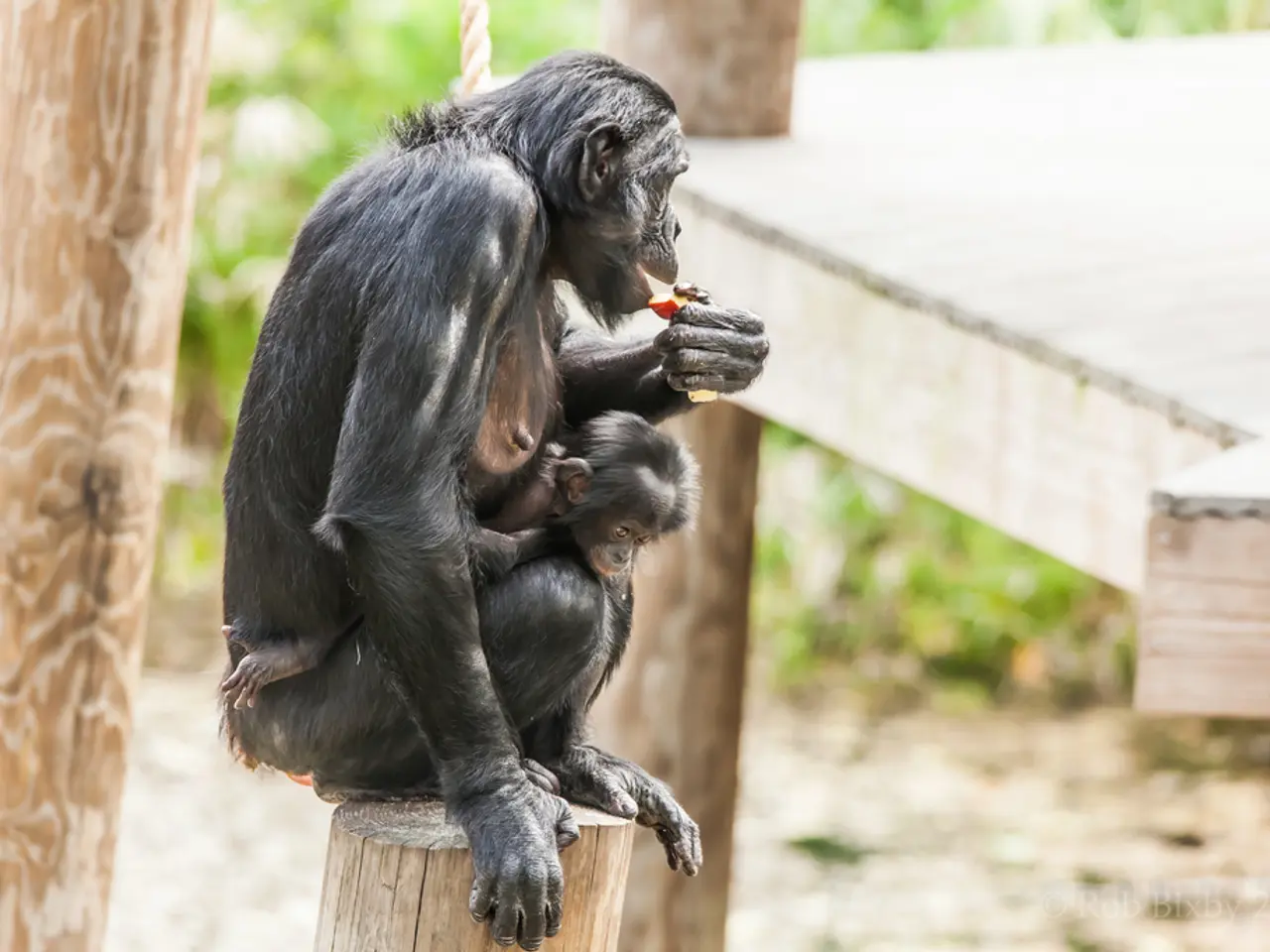
Research comparing muscle fibers of bonobos (close relatives of chimpanzees and humans) to human fibers shows that bonobo muscle fibers are larger and produce more force, though their specific tension and maximal shortening velocity (Vmax) are lower than humans. The apparent "super strength" in bonobos is linked to a higher proportion of fast-twitch (type II) muscle fibers, which provide more power but fatigue faster. Humans, on the other hand, have proportionally fewer type II fibers and more slow-twitch fibers, favouring endurance over maximum power.
Humans have evolved to prioritize endurance, dexterity, and brain function rather than raw strength. Our musculature supports prolonged aerobic activity rather than short bursts of maximum power. Anatomical changes such as upright bipedal locomotion, smaller jaws, and reduced muscle mass in the upper body reflect this evolutionary trade-off. Increased brain size and complex cognitive abilities demanded energy and structural adaptations that came at the expense of raw muscular strength.
Despite being weaker, humans succeeded as a species by developing tools, social cooperation, and cognitive skills. Endurance running, precise hand control, and complex communication are all key adaptations that gave humans an evolutionary advantage over stronger but less cognitively advanced primates.
In summary, humans are weaker than other primates primarily because our muscle anatomy, biomechanical advantages, and evolutionary adaptations shifted the emphasis from raw physical power to endurance, fine motor skills, and brain development. This allowed us to thrive as a species despite having less brute strength than close primate relatives like chimpanzees and gorillas.
Understanding the factors behind humans' comparative weakness offers valuable insights into human evolution and highlights the trade-offs that have shaped our species' extraordinary success. While modern lifestyles have led to a decline in muscle mass and physical fitness in many human populations, exacerbating the strength disparity between humans and other primates, it is essential to appreciate the unique evolutionary path that has made us who we are today.
[1] Lewin, R. (2007). The Human Lineage: How We Became Human. Harvard University Press. [3] Hildebrand, M. E., & Wood, J. L. (2007). Comparative Anatomy of the Vertebrates (6th ed.). Wiley-Blackwell. [4] Mitteroecker, P., & Manica, A. (2007). The Evolution of Strength and Locomotion in Humans and Apes. Springer.
- The unique path of human evolution, distinct from our primate relatives, has led to an emphasis on endurance, dexterity, and brain function, rather than raw strength.
- Research has shown that bonobos, our close relatives, have larger and more forceful muscle fibers, but humans have a higher proportion of slow-twitch fibers, favored for endurance.
- Modern lifestyles have contributed to a decline in muscle mass and physical fitness among humans, exacerbating the strength disparity between humans and other primates.
- Understanding the factors behind humans' comparative weakness provides valuable insights into human evolution and highlights the trade-offs that have shaped our species' success, particularly in travel, food, technology, lifestyle, science, medical-conditions, health-and-wellness, and fitness-and-exercise.




